 WallProof
The direct answer
%MC, %WME, relative readings and %RH describe different quantities or scales. Wood %MC relates water mass to dry wood mass. WME expresses a wood-equivalent electrical response. A relative scale compares responses under suitable conditions. %RH describes water vapour in air at its temperature. Identify the mode and material first; the numbers cannot be substituted for one another.
When this distinction matters
A report saying only “moisture: 22” cannot be interpreted reliably. It is missing the scale, material, instrument, mode, location and conditions. Even a percentage sign does not identify what is being measured.
This guide explains the labels. It does not provide a conversion calculator, mould threshold or universal dry/wet boundary. The Protimeter MMS3 Manual Rev3-1 supplies one model-specific example of modes and scales. Other instruments can use other ranges, calibrations or material settings.
Four scales at a glance
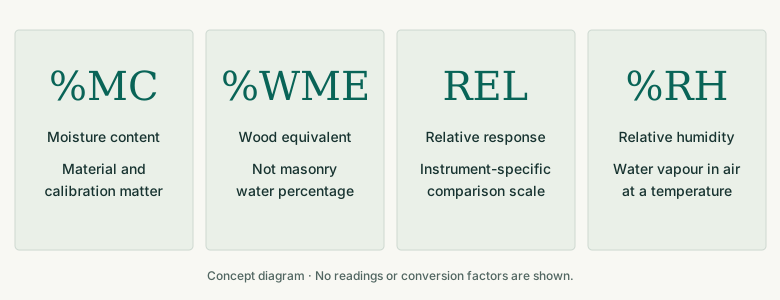
| Display or quantity | What it means | Essential condition | What it does not mean |
|---|---|---|---|
| Wood %MC | Water mass divided by oven-dry wood mass, expressed as a percentage; a meter estimates it using a calibration. | Appropriate species/material setting, temperature correction where required, and valid range and technique. | Air humidity, or an automatic installation approval. |
| %WME | Wood moisture equivalent: an electrical response expressed on a wood-equivalent scale. | Identify the non-wood material and the method. | The percentage by mass of water in plaster, brick or stone. |
| REL / relative | A device- and mode-specific indication, useful for comparisons under controlled conditions. | Comparable material, contact, mode and geometry. | A percentage, or a scale interchangeable with another instrument. |
| %RH | Relative humidity of air at the measured temperature. | Identify where the air was measured and allow the sensor to stabilise as specified. | The moisture content of the nearby wood or masonry. |
Wood moisture content is a mass ratio
For wood, the reference definition is:
MC (%) = (wet mass − oven-dry mass) ÷ oven-dry mass × 100.
A handheld meter does not normally weigh and oven-dry the board. It estimates MC from an electrical response and its calibration. This is why species or density settings, temperature and measurement conditions can matter. Wood changes towards equilibrium with its surrounding environment over time; a room’s RH reading is not an instant direct measurement of the board’s MC. Source: The Wood Database.
Do not borrow an example wood target from a general article and use it as a UK flooring acceptance limit. The specific floor, adhesive, subfloor, environment and specified test procedure must be considered together.
WME is especially easy to misread on walls
Resistance readings on non-wood materials may be expressed as WME. If a wall reading is reported as %WME, the label must stay attached to the number. Changing it to “the wall contains this percentage of water” loses the meaning of the measurement.
Masonry is heterogeneous. Salts, embedded metal and material variation can influence electrical responses; a high number needs investigation in context. A material sample analysed by an appropriate quantitative method answers a different question and only represents the sampled material and location. Source: Measuring Moisture in Masonry.
Relative scales belong to the instrument and mode
The MMS3 manual describes its non-invasive search readings on a 60–999 relative scale. That range is not a percentage and must not be generalised to all pinless instruments. Some meters offer calibrated wood modes as well as relative modes. Read the label and instructions for the one actually in use. Source: MMS3 manual.
A higher relative reading can help locate a change or prioritise further checks. For a trend to be meaningful, use comparable positions and conditions. Switching instrument, finish, setting or contact pressure may change the response without demonstrating a change in water content.
Record enough to interpret it later
Record the instrument and mode; value and unit; material and finish; position, depth or sensing mode; date; ambient conditions; and the check performed before use. Keep uncertainty in a separate note rather than silently selecting a convenient scale.
Use the wall record for a spatial pattern or the timber and floor record for material and installation context. See pin versus pinless for why two instruments can disagree.
Limits
No single scale diagnoses a leak, mould or a building defect. Colour-coded bands reflect an instrument’s configured interpretation; they are not a replacement for identifying the material or investigating a building. This guide explains units and scope, not site-specific acceptance criteria.
Sources & review
These sources were read to prepare this explanation. Manufacturer instructions describe their own instruments; they are not independent performance tests.
- Wood and MoistureEric Meier, The Wood Database · Independent author reference with commercial support
Defines wood moisture content using oven-dry mass, and explains equilibrium moisture content and dimensional movement. Its example targets are not UK flooring acceptance criteria.
- MMS3 instruction manualProtimeter · Manufacturer manual (PDF) · MMS3 Manual Rev3-1
Separates pin moisture measurements, non-invasive search mode and hygrometry; describes pin verification and non-invasive offset checks. Specifications and procedures apply to this instrument.
- Measuring Moisture in MasonryMatthew Wellesley-Smith, Hutton + Rostron; Building Conservation Directory · Specialist article by a building-surveying practitioner · 2024
Electrical readings need material and environmental context. Salts, metal, layers and voids complicate interpretation; sampling quantifies a sample rather than the whole wall.
Source review: 22 September 2026. No original instrument test or professional site inspection was carried out for this article. Read our methodology or report a correction.