 WallProof
The direct answer
A wall scanner can help identify possible concealed objects, but it cannot prove that a position is safe to drill. Treat its signal as one part of the evidence. Check the wall construction, available service information and the operating conditions for your exact instrument. If uncertainty about services remains, pause intrusive work and obtain competent help.
What this guidance applies to
This guide concerns preparation for drilling, sawing or fixing into domestic walls. It does not map electrical cable routes, specify electrical isolation procedures or approve a fixing. The model-specific reference is the Bosch GMS 120-27 UK English online manual, reviewed on 22 September 2026. Its instructions must not be assumed to apply to a Bosch D-tect model or another brand.
Bosch explicitly says the tool may not be completely accurate for technological reasons, and advises consulting other information such as building plans and construction photographs. Moisture, conductive finishes, metallic materials and foil insulation can impair measurement. The type and arrangement of hidden objects also matter. Source: Bosch safety instructions.
What the result actually tells you
| Observation | Reasonable interpretation | What it does not establish |
|---|---|---|
| A repeatable object indication | Something is producing a response under these conditions; investigate its location and type. | Exact identity, condition, depth for every mode, or that adjacent space is empty. |
| No indication or a green light | The detector has not indicated an object in that pass and mode. | Absence of all cables, pipes, framing or other obstructions. |
| A wide or nearly continuous indication | Construction, multiple targets or interference may be affecting interpretation. | A single large pipe, or a reason to ignore the entire signal. |
| An indication interpreted as framing | Possible framing or another detectable feature. | Load capacity, a suitable fixing specification or freedom from nearby services. |
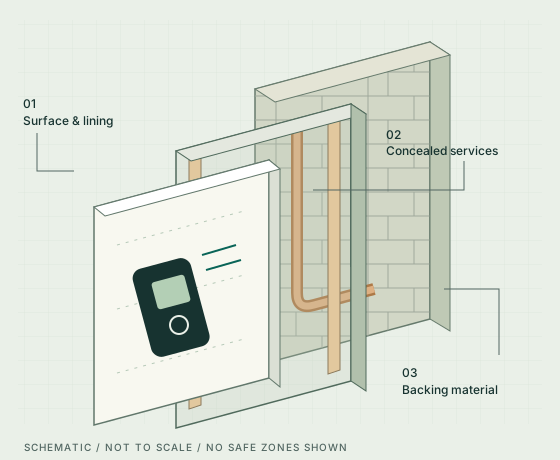
These are interpretations of evidence, not measured probabilities of detection. WallProof has not tested the detector on the wall illustrated.
A useful sequence before intrusive work
- Define the job. Identify the proposed fixing position, intended penetration and what must be supported. Selecting a fixing and checking load capacity are separate from detecting objects.
- Gather context. Use reliable plans, construction photographs and visible evidence of the wall and nearby services. Records can be incomplete or out of date; treat them as supporting evidence.
- Read the exact manual. Check that the instrument and mode cover the intended material and target. Check the sensor face, battery and any error indications. Allow the instrument to adapt to conditions if its manual requires it.
- Scan as instructed and record uncertainty. Keep the required contact and motion. Compare repeat passes rather than retaining only the result you hoped for. The relevant manual determines how to mark an indicated object.
- Resolve conflicting evidence. If construction or service routes remain unclear, do not make an exploratory hole simply because a display looks reassuring. A competent installer may need another method or access to additional evidence.
- Apply the precautions required before work. Live-cable detection is not proof of electrical isolation. Follow the relevant safety procedures and obtain qualified help where required.
Some detectors’ live-cable detection needs particular electrical conditions. Do not confuse those detection conditions with the safe condition for subsequent drilling. A scanner is not a voltage-proving instrument. Consult the model’s full operating instructions.
Why the same wall can give different signals
Different modes may respond to different properties. A lining, void, foil layer or neighbouring fixing can affect the signal, while poor contact or electromagnetic interference can affect the instrument. The GMS 120-27 manual lists temperature and sensor-contact problems among its error conditions. Source: error guidance.
Use the UK wall materials guide to think through the build-up. A signal that changes when technique or mode changes needs explanation; it is not automatically evidence that the target disappeared.
Limits of this checklist
No checklist here authorises drilling into an unknown wall. It does not verify a service-free area, wall condition or fixing capacity. Nor does a test on a known object prove detection of every hidden object at every depth. We provide source-based context; the actual work requires the instrument instructions and appropriate site-specific judgement.
Sources & review
These sources were read to prepare this explanation. Manufacturer instructions describe their own instruments; they are not independent performance tests.
- GMS 120-27: Safety instructionsRobert Bosch Power Tools · Manufacturer manual · UK English online manual; displayed last change 7/4/2024
Other information is needed before drilling. Moisture, foil, metal and conductive surfaces can impair accuracy; wall and fixing load capacity require separate checks.
- GMS 120-27: How it works and locating objectsRobert Bosch Power Tools · Manufacturer manual · UK English online manual; displayed last change 7/4/2024
Detection and classification are conditional. Read the exact operating instructions for the model and mode, including live-cable limitations and precautions before work.
- GMS 120-27: Errors — causes and corrective measuresRobert Bosch Power Tools · Manufacturer manual · UK English online manual; displayed last change 7/4/2024
Temperature, interference, sensor contact and calibration faults can affect readings. The remedies are model-specific.
Source review: 22 September 2026. No original instrument test or professional site inspection was carried out for this article. Read our methodology or report a correction.