 WallProof
The direct answer
A scanner responds through a wall’s layers, not to a universal “UK wall” material. Conductive finishes, foil and metal can interfere with detection; mixed construction can make an indication harder to interpret. Start by identifying the likely build-up and checking the instrument’s approved use. An unexpected signal is a question to investigate, not a reliable picture of the wall.
Scope: a construction checklist, not a performance table
UK homes contain different construction periods, alterations and repairs. A wall can include a newer lining over older masonry or a change of material within the same surface. This guide uses common construction descriptions to organise questions. It does not report tests, detection rates or correction factors for these wall types.
The Bosch GMS 120-27 safety instructions explicitly identify moisture, metallic building materials, foil-laminated insulation, conductive wallpaper and tiles as possible influences. The consequences for a particular wall or another detector cannot be quantified from that warning alone. Source.
Read the build-up from surface to backing
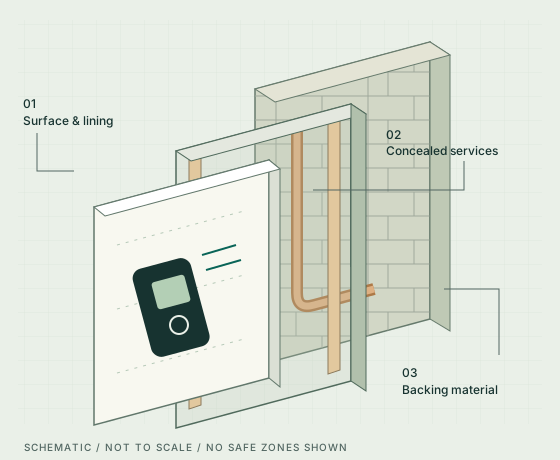
| Build-up or feature | What to establish | Interpretation to avoid |
|---|---|---|
| Plasterboard on timber framing | Board layers, framing, fixings and possible services; whether the chosen mode is specified for this application. | “Every indication is a wooden stud.” |
| Plasterboard on metal framing | Whether metal framing and its fixings could explain repeated metal indications. | “The detector can distinguish every fixing, frame and pipe from one pass.” |
| Dot-and-dab lining over masonry | The separate lining, adhesive, void and backing; whether the manual covers the task and expected target. | “The display is a direct cross-section through the whole assembly.” |
| Foil-backed lining or insulation | Whether a conductive layer may obscure or alter the useful signal. | “Foil adds a known amount to the depth, so subtract it.” |
| Lath and plaster, metal mesh or repaired areas | Mixed layers, numerous fixings and local changes of construction. | “The age of the house identifies the exact layers.” |
| Brick or stone with plaster/render | The finish, possible reinforcement or embedded metal, depth and target type. | “A detector’s maximum advertised depth applies unchanged.” |
| Tiles or conductive wall coverings | Whether the surface is compatible with the instrument and allows the required contact. | “A smooth surface guarantees reliable contact and detection.” |
The entries are an editorial checklist based on how layers and target arrangements affect interpretation. They are not a manufacturer’s tested compatibility list. Use the exact manual for claims about model capability.
A specific limit in the GMS 120-27 manual
Bosch says to enable the wood detection function only when searching dry walls with a wooden substructure; on other surfaces the result may be impaired. A plasterboard face alone does not establish that this condition is met. In particular, describing a wall as dot-and-dab does not turn it into a timber-framed wall. This is a mode-specific instruction, not proof that the whole instrument cannot produce any useful response on another construction. Source: How it Works.
The same manual warns that a non-metallic indication can, in some circumstances, come from a water-filled plastic pipe, power cable or gas line. Nails and screws can also cause a wooden beam to be identified as metal. Keep the indicated class separate from a confirmed object identity.
What to do with a broad or inconsistent response
First check the instrument’s condition and error indications. The GMS 120-27 error instructions distinguish temperature, electromagnetic interference, sensor contact and possible calibration faults. A broad signal on the wall is not by itself proof that recalibration is required. Source.
Next, review what you know about the construction. Reliable renovation records, exposed edges that can be viewed without damaging anything, and photographs taken before a lining was closed may help. Mark uncertainty explicitly: “foil backing suspected” is different from “foil observed”.
Then follow the instrument’s scanning procedure and compare repeatable observations. If the signal still cannot be explained, treat that as a limit of the current evidence. Do not create a universal offset or treat the highest-amplitude area as a fully identified object.
A known-object check has a limited job
A response to a known target can show that the instrument responds in those test conditions. It does not prove that a smaller, deeper or differently oriented target behind a different material will be found. A meaningful future test would record the complete layer arrangement, known target, spacing, instrument mode and missed as well as detected targets.
WallProof has not performed that test series. Our drawings and comparisons are explanatory. No material here is labelled “safe to drill” or “scanner-proof”.
Next steps and limitations
Return to the before-drilling checklist to combine construction information with other evidence and safety precautions. If you are trying to explain a moisture indication rather than locate an object, use high wall readings: the measurement principles and investigation question are different.
A scanner result cannot establish structural capacity, certify that a cable is isolated or exclude concealed services. Unresolved service risk needs competent site-specific help before intrusive work.
Sources & review
These sources were read to prepare this explanation. Manufacturer instructions describe their own instruments; they are not independent performance tests.
- GMS 120-27: Safety instructionsRobert Bosch Power Tools · Manufacturer manual · UK English online manual; displayed last change 7/4/2024
Other information is needed before drilling. Moisture, foil, metal and conductive surfaces can impair accuracy; wall and fixing load capacity require separate checks.
- GMS 120-27: Errors — causes and corrective measuresRobert Bosch Power Tools · Manufacturer manual · UK English online manual; displayed last change 7/4/2024
Temperature, interference, sensor contact and calibration faults can affect readings. The remedies are model-specific.
- GMS 120-27: How it works and locating objectsRobert Bosch Power Tools · Manufacturer manual · UK English online manual; displayed last change 7/4/2024
Detection and classification are conditional. Read the exact operating instructions for the model and mode, including live-cable limitations and precautions before work.
Source review: 22 September 2026. No original instrument test or professional site inspection was carried out for this article. Read our methodology or report a correction.