 WallProof
The direct answer
A high electrical reading on a wall is a reason to investigate, not proof of a leak, rising damp, mould or a building defect. First identify the instrument mode, scale and material. Then compare a recorded pattern with visual observations, construction and conditions. Moisture may contribute to the response, but salts, metal, layers and technique can also affect it.
Scope: information for an investigation
This guide is for interpreting an unexplained wall reading and preparing a useful record. It does not remotely diagnose the wall, determine a repair or give a mould clearance criterion. The RICS, Historic England and PCA joint statement concerns traditional buildings; its emphasis on a whole-building approach should not be mistaken for a test procedure covering every modern assembly. Joint statement.
If there is visible water near electrical equipment, structural instability or another immediate hazard, obtain appropriate urgent local help rather than continuing a measurement exercise. Where damp or mould is already evident, a reassuring meter reading is not a reason to disregard the observed problem. See the RICS consumer guide.
Start by preserving the label
Write down the exact display, including %WME, REL or the stated material mode. A number on a wood-equivalent scale is not the wall’s percentage of water by mass. The guide to scales explains why. The MMS3 manual, for example, distinguishes wood/pin measurement from non-invasive search readings. Manufacturer source.
Map the observation, not a diagnosis
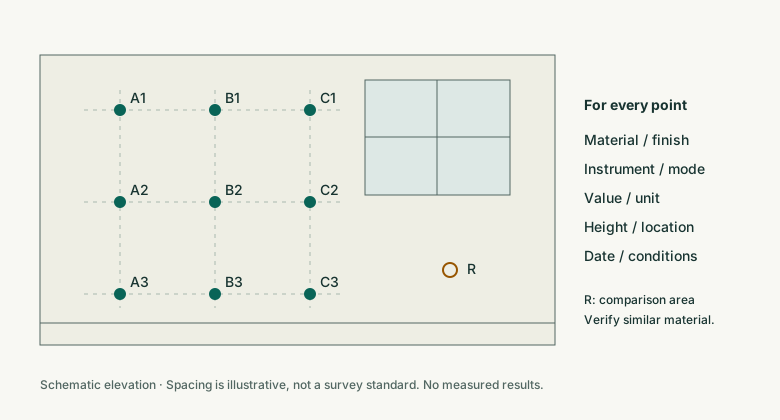
| Keep in the record | Why it matters |
|---|---|
| Point location, height, material and finish | A change from plaster to timber or mortar is not a like-for-like comparison. |
| Instrument, identifier, mode, scale and pre-use check | A later reader must know what the number represents. |
| Repeat readings and contact or probe arrangement | Technique and measurement volume affect comparison. |
| Date, weather, heating and ventilation observations | A single visit is a snapshot of changing conditions. |
| Visible staining, salt deposits, damage and other observations | Measurement needs context; observations should not be replaced by a coloured display. |
| Known or suspected metal, foil and construction changes | These can offer alternative explanations for electrical responses. |
| Photograph references and unresolved questions | Keep evidence separate from inference. |
Use the blank wall measurement CSV. A comparison area should have comparable material and finish; calling it “dry” does not independently prove that it is dry.
Plan the next checks
- Confirm the measurement setup. Identify the scale, check the instrument and repeat with the prescribed contact and mode.
- Look at the building. Record the relevant internal and safely visible external condition, alterations, drainage or rainwater details and the history of the reported problem. Avoid deciding on a cause from a single pattern.
- Consider competing explanations. In masonry, salts and embedded metal can influence electrical readings. A foil-backed lining can also mislead a surface reading. A contractor case illustrates that possibility, but does not provide a universal correction factor. Specialist explanation; commercial case account.
- Compare observations over time where appropriate. Use the same identified points and compatible conditions, while recording what changed. A changing value needs interpretation, not just a trend line labelled “drying”.
- Ask what additional evidence would change the decision. A competent investigator may combine environmental monitoring and other methods, and use justified sampling if a specific question requires it. The method should suit the material and avoid unnecessary damage.
This order is our editorial synthesis of the whole-building approach and the specialist masonry article. It is not a certified survey protocol.
When a more quantitative test helps
An appropriate analysis of a material sample can quantify moisture in that sample, at its location, depth and time. It does not automatically quantify the entire wall or establish why the moisture is present. Sampling design, salt assessment and other evidence may be important to the question. Source: Measuring Moisture in Masonry.
Ask an investigator to explain what they observed, which readings are relative, what alternative causes were considered and why any proposed test or repair is justified. If the same business sells remedial work, that financial interest should be transparent; it does not by itself invalidate or confirm its findings.
Limits
A high reading is not a mould test. A thermal pattern is not direct evidence of water by itself. A low surface response cannot exclude moisture deeper within a mixed wall. Neither this guide nor a meter display substitutes for a competent assessment of the particular building and the people using it.
Sources & review
These sources were read to prepare this explanation. Manufacturer instructions describe their own instruments; they are not independent performance tests.
- Measuring Moisture in MasonryMatthew Wellesley-Smith, Hutton + Rostron; Building Conservation Directory · Specialist article by a building-surveying practitioner · 2024
Electrical readings need material and environmental context. Salts, metal, layers and voids complicate interpretation; sampling quantifies a sample rather than the whole wall.
- Investigation of moisture and its effects on traditional buildings: principles and competenciesRICS, Historic England and Property Care Association · Joint professional statement (PDF) · 2022
A whole-building investigation considers construction, history, defects, environment and occupant observations; techniques must suit the question and fabric.
- Damp and mould: consumer guideRoyal Institution of Chartered Surveyors · Professional body consumer guidance · 2025
Explains the need to understand causes and obtain appropriate advice about damp and mould.
- MMS3 instruction manualProtimeter · Manufacturer manual (PDF) · MMS3 Manual Rev3-1
Separates pin moisture measurements, non-invasive search mode and hygrometry; describes pin verification and non-invasive offset checks. Specifications and procedures apply to this instrument.
- Electronic damp/moisture meters and foil backing: an exampleBryan Hindle, Preservation Expert · Commercial damp-treatment contractor case account · 2011
Illustrates possible foil interference in an electrical reading. It is a contractor’s case account, not a controlled comparison or a universal material correction.
Source review: 22 September 2026. No original instrument test or professional site inspection was carried out for this article. Read our methodology or report a correction.